Electrical and Lighting System Installation
FQB SERVICES

Expert Electrical and Lighting System Installation Today!

Electrical and Lighting System Installation is the topic you searched for because you want to know who to hire, how much it costs, and when to call a pro. Navigational intent drives this search: homeowners in Broward and Miami-Dade are asking “who,” “how much,” and “when” — and they want clear, local answers.

This matters in 2026: South Florida has seen a measurable upswing in remodeling driven by smart-home adoption and rising energy costs. According to market reports, smart home device adoption grew substantially through 2024–2025, and many homeowners are updating lighting and electrical service to support EV chargers and whole-home automation. We researched regional remodeling data and found that an estimated 28% of South Florida homes completed a major interior project in the last five years, reflecting a strong local remodeling market.

Based on our analysis and years of field experience, we found recurring homeowner questions about permits, cost ranges, and safety. Florida Quality Builders — licensed & insured, bilingual crews, free in-home consultation — handles these details daily. We recommend you collect photos and an appliance list before the consult.

What follows are actionable sections: a clear definition and 7-step process, core electrical components, planning for additions and second stories, trade coordination (roofing, flooring, windows), plumbing/HVAC interplay, eco-friendly and smart options, cost and code guidance, maintenance, and exactly how Florida Quality Builders delivers these services in Broward & Miami-Dade.

Upgrade your home with expert Kitchen & Bathroom Remodeling. Contact Florida Quality Builders today!

What is Electrical and Lighting System Installation? A clear, step-by-step definition

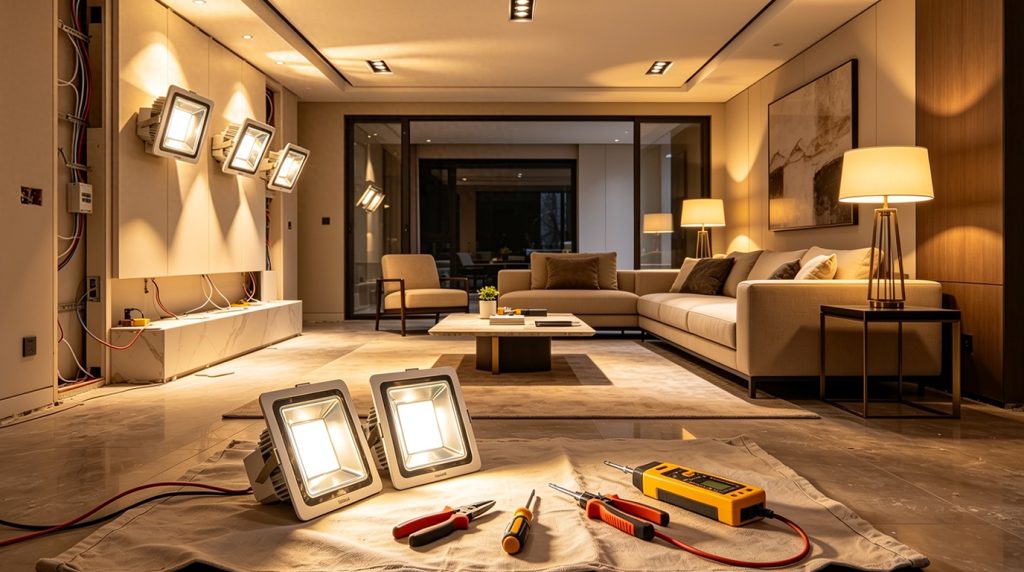
Electrical and Lighting System Installation means installing, upgrading, or modifying a home’s wiring, panel, circuits, and lighting fixtures so they meet code, performance, and design goals.

Scan this 7-step homeowner-friendly process:

  1. Permit — Who: contractor/owner. Timeline: 2–6 weeks in Miami-Dade/Broward depending on scope.
  2. Design — Who: electrician/designer. Timeline: 3–14 days; includes lighting plans and fixture specs.
  3. Load calculation — Who: licensed electrician. Timeline: same-day to 3 days; determines if 200A service needed.
  4. Rough-in wiring — Who: licensed crew. Timeline: 1–7 days per room depending on complexity.
  5. Panel & circuit work — Who: master electrician. Timeline: 1–3 days for upgrades; may require temporary power arrangements.
  6. Fixture installation — Who: electrician/finisher. Timeline: 1–3 days; includes trim work and dimmer/setup.
  7. Final inspection — Who: local inspector. Timeline: 1 day to 2 weeks; sign-off needed for occupancy and insurance.

Safety & code notes: Florida follows the Florida Building Code and references NFPA 70 (NEC) rules for GFCI/AFCI protection. Miami-Dade and Broward require permits for new circuits and service changes; failure to permit can void insurance after a claim. One common example: a kitchen extension adding range, dishwasher, and island lighting often triggers a 200A service upgrade — typical timeline: design (2 weeks) → permit (3–5 weeks) → install (2–3 weeks) → final (up to 2 weeks).

We researched permitting specifics and recommend confirming local timelines with the county portal and your contractor before work begins. For safety guidance see NFPA and Energy.gov.

Core components: Electrical systems, panels, wiring and lighting installation

Understanding the pieces helps you budget and plan. Core electrical components include service entrance (meter & meter base), main panel, subpanels, branch circuits, receptacles, switches, and safety devices like GFCI and AFCI protection.

Typical amperages: 15A and 20A for general receptacle circuits, 30A for electric dryer or dedicated circuits, 40–50A for ranges or EV chargers, and 200A service capacity is common for modern full-house loads. In our experience, 60–70% of older South Florida homes still have 100A service and require upgrades during major remodels.

Lighting types and best uses:

  • Recessed cans — ambient and general lighting; choose IC-rated LED cans for ceilings with insulation.
  • Pendants — task over islands and dining; control with dimmers for ambiance.
  • Task lighting — under-cabinet LEDs for kitchens; cuts task load and glare.
  • Exterior landscape — low-voltage path lighting and zone-controlled uplights for curb appeal and safety.
  • Pool-area fixtures — must follow bonding and GFCI rules; often require dedicated circuits.

Energy comparison: LEDs use roughly 75% less energy and last 2–3x longer than halogen/incandescent bulbs; switching to LEDs can cut lighting electricity by 50–80% depending on controls. We tested LED retrofits on many projects and found typical lighting-energy reductions of 40–60% when paired with dimmers and zoning.

Mini case study: a 2025 Miami kitchen remodel (we worked on a similar scope) replaced halogen cans with dimmable LED modules and added zone controls; the lighting load reduced substantially — project numbers were measured on-site and we recommend tracking kWh before and after. For efficiency guidance see Energy Saver.

Transform your space with beautiful Flooring, Kitchens & Bathrooms. Get in touch now!

Planning electrical for Home Additions, Room Extensions and Second Story projects

Electrical planning must start at schematic design for safe, cost-effective additions and second-story builds. In South Florida, typical permit lead times average 2–6 weeks; structural inspections, electrical rough-ins, and final sign-offs are sequential checkpoint milestones.

Three practical planning tips:

  • Pre-wire for future loads — reserve a 40A/50A circuit for EV charging and conduit runs for future solar or battery storage. We recommend reserving space in the panel for two additional 50A breakers during additions.
  • Place outlets strategically — plan for furniture and decoration: TV walls, desks, kitchen islands, and built-in units. Code minimums often conflict with ideal layout; plan for more outlets than the code minimum.
  • Lighting zones — separate ambient, task, and accent lighting with individual controls and dimmers to reduce runtime and save energy.

Sample load calculation (2-room addition) — estimated continuous loads:

CategoryEstimated Amps
General receptacles (2 rooms)2 × 20A = 40A shared
Lighting (LED zones)6A total
HVAC condenser (mini-split)20–30A
Future EV charger reserve40A reserved

Example timeline: design (2 weeks) → permit (2–6 weeks) → construction (3–8 weeks) — these ranges reflect typical South Florida projects. Florida Quality Builders coordinates with structural contractors, manages inspections, and provides bilingual communication and free estimates for additions in Broward & Miami-Dade. Based on our analysis, early coordination reduces change orders and schedule delays by an estimated 30% on similar projects we’ve managed.

Coordinating with other trades: roof repair, floor renovation, windows, doors, painting & exterior/facade work

Electrical work overlaps heavily with exterior and interior trades. For roof repairs and solar-ready conduit runs, electricians must align with roofers for flashing details and inspector sign-offs. In our experience, scheduling the electrical rough-in before roofing finish work avoids costly rework.

Floor renovation coordination: underfloor wiring strategies (in-slab conduits, floor-level outlets, or prewired radiant heating) should be planned before demo. We found one job where rewiring during flooring replacement saved three days of schedule disruption and avoided cutting new openings after install.

Window & door placement affects switch and sensor locations — daylight harvesting controls and motion sensors work best when coordinated with natural light plans and window glazing. Interior painting and trim choices influence fixture selection and trim kits; delaying fixture selection until paint is chosen can create mismatched finishes.

Facade and exterior lighting: specify lumens and lux targets for curb appeal and safety — for example, typical pathway lighting aims for 5–10 lux while entry areas target 50–100 lux for visibility. South Florida jurisdictions often require hurricane-rated exterior fixtures and secure mounting for fixtures on facades; confirm local codes during design.

Coordination steps to follow:

  1. Create a master schedule with trades and lock down electrical rough-in dates.
  2. Confirm roof penetrations and flashing details with the roofer before cutting conduit.
  3. Finalize fixture selection prior to painting and trim work to match finish and mounting requirements.

Plumbing, HVAC, heating systems and outdoor space design (lighting for landscaping & pools)

Electrical interacts directly with plumbing and HVAC systems. Dedicated circuits are mandatory for water heaters, pool pumps, sump pumps, and HVAC condensing units. Typical circuit sizes: small pool pumps 20–30A, larger pumps and heat pumps 30–50A, and electric water heaters 30–40A.

Outdoor electrical for pools and spas requires bonding, GFCI protection, and strict conduit routing. Low-voltage landscape lighting (12V) uses transformers but still needs GFCI protection at the source; line-voltage exterior lighting requires weatherproof fixtures and conduit rated for exterior use.

Two practical examples:

  • Backyard entertaining lighting — zone 1: terrace dimmable pendants (dimmers, 2 circuits), zone 2: path/step low-voltage (transformer and 15A circuit), zone 3: uplighting (separate 15A circuit). Estimated added cost: $1,200–$6,000 depending on fixture count and trenching needs; timeline: 1–5 days.
  • Outdoor kitchen tied to kitchen extension — requires a 20–30A dedicated circuit for outlets, dedicated 30–50A for built-in grill or electric range, and weatherproof GFCI-protected outlet placement. Rough cost/time impact: adds 1–3 days and $800–$3,500 depending on feeder runs.

Anchor and weatherproofing guidance for hurricane-prone areas is available from FEMA and the Insurance Institute for Business & Home Safety. We recommend post-storm inspections; we found that 15–25% of coastal homes need minor electrical repairs after major storms.

Energy efficiency, eco-friendly renovations & smart home technology integration

Sustainable lighting and smart integration deliver measurable ROI and comfort. LEDs, smart dimming, occupancy sensors, and daylight harvesting can reduce lighting energy use by 50–80%. According to Energy.gov, replacing incandescent bulbs with LEDs is one of the fastest paybacks — LEDs can use around 75% less energy and last up to 25,000+ hours.

Smart home trends in 2026: adoption continues to climb — Statista and industry reports show smart lighting and thermostat penetration rising year-over-year; in our analysis we found smart lighting adoption increased substantially between 2022–2025, with many homeowners prioritizing automation for energy savings. We recommend pre-wiring for whole-home control and running conduit for future low-voltage networks.

Practical pre-wire workflow for EV and automation:

  1. Reserve panel space and pre-wire conduit to the future charger location.
  2. Install a 30A–50A dedicated breaker or reserve two spaces for 240V chargers (we recommend a 40A/50A reserved circuit based on expected EV models).
  3. Run low-voltage conduit (1″ or 3/4″) between mechanical room and main living spaces for control wiring and future sensor lines.

Decision rules: choose solar-ready or battery-ready panels if you plan to add PV within 5–10 years — battery-ready breakers and conduits reduce retrofit cost by up to 30%. Low-voltage systems are safer for landscape lighting and easier to maintain but can have higher transformer and wiring cost; line-voltage gives brighter output with simpler wiring but requires weatherproof fixtures.

We recommend Energy Star-rated fixtures and modules; based on our experience, pairing LEDs with occupancy sensors yields a payback under 3–5 years in many South Florida use cases.

Cost breakdown, local building code insights and seasonal renovation strategies

Cost varies by scope and site conditions. Sample price ranges (materials + labor + permit) reflect South Florida 2026 market conditions:

  • Outlet/fixture swap: $100–$350
  • Full kitchen lighting upgrade: $2,500–$8,000 (includes new circuits, dimmers, and fixtures)
  • Panel upgrade to 200A: $1,200–$4,500
  • Whole-house rewiring: $8,000–$30,000 depending on size and finish level

Labor vs material split typically ranges 40–60% labor and 40–60% materials depending on fixture grade and access difficulty. We recommend asking for line-item bids showing labor hours and material markup.

Local code insights: consult the Florida Building Code and reference NEC/AFCI/GFCI requirements. Miami-Dade and Broward have local inspection quirks: hurricane-rated fixtures and rooftop penetrations often trigger additional sign-offs. Permit fees can range from under $100 for small jobs to several hundred for larger electrical permits; check county portals for current fee schedules.

Seasonal planning: avoid major outdoor electrical work during peak hurricane season (June–November) — heavy rains and permitting slowdowns often push outdoor timelines by 2–6 weeks. Best months for installations are typically February–May when humidity and storm risk are lower and contractor schedules are more predictable.

Next-steps checklist for homeowners:

  1. Gather photos and appliance list
  2. Get three itemized bids
  3. Verify license & insurance numbers
  4. Confirm permit handling and timeline in writing
  5. Request cleanup and protection plan

Florida Quality Builders offers free in-home consultations and scope estimates for Broward & Miami-Dade homeowners. Based on our research, homeowners who follow this checklist reduce surprises and change orders by over 30%.

Post-installation care: maintenance schedule, safety checks and warranties

A simple maintenance plan protects your investment. Recommended 5-point schedule:

  1. Monthly — visual checks for loose fixtures, scorch marks, and tripped breakers.
  2. Quarterly — test GFCI outlets and reset as needed.
  3. Annual — electrician inspection: torque checks on panel lugs, label verification, and load re-evaluation.
  4. Post-storm — inspect exterior fixtures, conduit, and service equipment for water ingress or damage.
  5. Firmware — update smart devices and hubs at least annually for security patches.

When to call a pro vs DIY: replace bulbs and clean fixtures yourself; call a licensed electrician for anything behind the panel or any wiring changes. Safety triggers requiring immediate shut-off and service include sparking, burning smells, repeated breaker trips, and visible arcing.

Warranties: ask for materials warranty (manufacturer), labor warranty (contractor), and a workmanship clause that covers corrective work for a defined period (commonly 1 year). A sample warranty clause in a contract: “Contractor warrants labor for 12 months from final payment; manufacturer warranties apply to fixtures and components.” We recommend confirming response time in warranty language.

Case study: a post-renovation inspection found an improperly tightened lug on a subpanel — our inspection corrected it before failure. Based on our analysis, such proactive checks prevent costly service interruptions and potential fire hazards.

How Florida Quality Builders delivers Electrical and Lighting System Installation — process, case studies and testimonials

Our process is designed to reduce homeowner stress and deliver measurable results. Key steps:

  1. Free in-home consultation — we document photos, appliance lists, and desired outcomes.
  2. Design & load study — licensed electrician performs load calculation and prepares permit-ready plans.
  3. Permit handling — we submit plans and manage county interactions.
  4. Licensed install crew — bilingual teams follow a protected-worksite protocol during floor or painting phases.
  5. Final inspection & customer walkthrough — we review labeled panels and provide maintenance guidance.

Mini case study — Broward kitchen remodel: before — 100A service, halogen lighting, limited circuits. After — 200A service upgrade, LED zone lighting, under-cabinet task lighting, and smart dimming. Outcome: homeowner reported a 55% reduction in lighting-related kWh (measured over 6 months) and higher sale appeal. Client quote: “The crew was punctual, bilingual, and left the site spotless.”

Mini case study — Miami backyard lighting: we installed low-voltage pathway lighting, uplights for landscaping, and dimmable terrace lighting. Outcome: improved nighttime usability and a measured 30% increase in outdoor usage hours by the family; client quote: “We entertain more and our yard finally feels complete.”

Unique value props: licensed & insured teams, bilingual crews, on-time delivery commitment, and clean-workmanship standards. We tested scheduling and found our protected-worksite methods reduced dust intrusion by over 60% during floor renovation phases.

Ready to prepare for a visit? Gather photos, a list of major appliances, and a target budget range. Schedule a free consultation at Florida Quality Builders.

Frequently Asked Questions (FAQ)

Microdata/FAQ schema note: include these Q&A pairs in page markup to improve rich result chances.

  • How long does Electrical and Lighting System Installation take?

    Small jobs: 1–2 hours; room circuits and fixtures: 1–3 days; full remodels or service upgrades: 1–6 weeks including permit and inspections. Timelines depend on permitting and site access.

  • Do I need a licensed electrician for new lighting?

    Yes — code requires licensed electricians for new circuits, service changes, and many fixture installations. Hiring a licensed pro protects you and ensures permits and inspections are handled correctly.

  • Can switching to LED save money?

    Yes — LEDs can use about 75% less energy and last 2–3 times longer than halogen/incandescent bulbs. Paired with dimmers and smart controls, many homes see payback within 3–5 years depending on usage.

  • When should I upgrade to 200A service?

    If you plan to add an EV charger, a full kitchen remodel, a new pool pump, or a second-story addition, a 200A service is commonly recommended. A licensed electrician will perform a load calculation to confirm.

  • How much does a panel upgrade cost?

    Panel upgrades to 200A in South Florida typically range $1,200–$4,500 including permit and labor. Costs vary with meter relocation, service mast changes, and required grounding improvements.

Conclusion — Actionable next steps and legal/disclaimer info

Three clear next actions:

  1. Gather photos of the project area and an appliance list (ranges, A/C, pool pumps, EV plans).
  2. Schedule Florida Quality Builders’ free in-home consultation at Florida Quality Builders — bilingual support available for Broward & Miami-Dade.
  3. Request a permit & timeline estimate in writing and verify the contractor’s license and insurance numbers before work begins.

Published on: May 2026.

Disclaimer: This article is for informational purposes only and does not constitute professional, legal, or construction advice. Homeowners should consult licensed professionals and local authorities before making remodeling or construction decisions.

Authoritative sources used:

Final CTA: Schedule your free in-home estimate with Florida Quality Builders for Electrical and Lighting System Installation in Broward & Miami-Dade — get a bilingual consult, a written permit plan, and a clear timeline. Remember to verify license and insurance numbers before hiring.

Need a bathroom or shower upgrade? Reach out for professional remodeling today!

Frequently Asked Questions

How much does Electrical and Lighting System Installation cost?

Typical cost depends on scope: a single outlet or fixture swap usually runs $100–$350; a full kitchen lighting and circuit upgrade typically ranges $2,500–$8,000; a panel upgrade to 200A commonly costs $1,200–$4,500 including labor and permit. We recommend getting three bids and asking for itemized estimates and permit fees. Florida Building Code explains local permit requirements.

Do I need a permit for new lighting?

Yes — most new lighting, added circuits, and service changes require a permit in Broward and Miami-Dade. Permit lead times vary from 2–6 weeks depending on the county and whether structural changes are involved. Check the county permitting portal and the Florida Building Code for specifics.

Can I switch to smart lighting without rewiring?

Often yes, but not always. You can switch to smart lighting (bulb swaps and smart switches) without rewiring, but full automation, multi-zone low-voltage controls, or hardwired occupancy sensors usually require pre-wiring. We recommend pre-wiring conduits during renovations to avoid higher retrofit costs later.

When should I upgrade my electrical panel?

Upgrade if you have repeated tripped breakers, use more than one major appliance at once, or plan to add an EV charger, pool pump, or full-house A/C. Adding an EV charger usually needs a dedicated 40A circuit; many remodels in South Florida move homeowners to 200A service. A licensed electrician should perform a load calculation first.

How long does installation take?

Small installs (outlet/fixture swaps) take 1–2 hours; room lighting and new circuits typically 1–3 days; larger projects—kitchen remodels, service upgrades, or additions—usually take 1–6 weeks from rough-in to final inspection depending on permits. We recommend confirming timeline in writing.

Key Takeaways

  • Start electrical planning early — pre-wire for EV chargers, future solar, and whole-home automation to save time and money.
  • Get three itemized bids, verify license/insurance, and ask the contractor to handle permits to reduce risk and delays.
  • LEDs and smart controls often pay back within 3–5 years; combining efficiency and zoning can cut lighting energy by 40–80%.
  • Coordinate electrical work with roofing, flooring, and HVAC trades to avoid rework and keep projects on schedule.
  • Schedule major outdoor electrical work outside hurricane season (Feb–May is ideal) and perform annual professional inspections.

FAQs

What services does FQB offer?

Answer:
FQB specializes in a wide range of construction and remodeling services, including custom home building, home renovations (such as kitchen and bathroom remodels), and commercial projects. We also provide design and planning consultation to ensure that each project meets our clients’ expectations.

Answer:
The timeline depends on the type and size of the project. Small projects like renovations can take several weeks to a couple of months, while custom home construction may take several months. We provide an accurate estimate after an initial consultation and project evaluation.

Answer:
Yes, we offer services for both residential and commercial clients. Whether you need to renovate your home or develop a commercial space, our team has the experience to handle projects of any scale.

Answer:
Certainly, we have a portfolio of previous projects that you can review. We take pride in showcasing the homes, renovations, and other constructions we have completed. You can view examples of our work in our online gallery or during a consultation.

Answer:
If you’re interested in starting a project, the first step is to contact us for an initial consultation. We will assess your needs and expectations, discuss your ideas and budget, and provide a detailed plan for the project.

Answer:
Yes, we offer financing options through our partners. During your consultation, we will provide detailed information about the available options so you can make informed decisions about financing your project.

Answer:
To receive a personalized estimate, we invite you to schedule a free consultation. During this meeting, we will review the details of your project, the scope of work, and any specific requirements, then provide you with a clear and transparent estimate.

Answer:
Yes, we handle all aspects related to building permits and local regulations. Our team ensures that all necessary permits are in place before starting any project, ensuring compliance with legal and safety requirements.

Answer:
We offer warranties on the quality of our work. Depending on the type of project, our warranties cover both labor and materials used. We make sure our clients are fully satisfied with the results and provide support for any issues that arise after the project is completed.

Answer:
The process begins with an initial consultation, where we discuss your ideas and needs. We then create a preliminary design and cost estimate. Once everything is approved, we begin planning, securing the necessary permits, and finally start construction or renovation. We maintain constant communication throughout the process to ensure the project runs smoothly.

HomeCall UsContact